Tips for a Green and Socially-Responsible Holiday Season
Festive & easy ideas by my good friend Rachael, my green heroine!!
1. Recycle your tree
Did you know that you actually can purchase a live Christmas tree that can be replanted post-holiday season? If you’re not into living trees then you can still purchase a cut tree, but make sure to take the extra step of recycling it instead of sticking it out with the trash! Go to Earth911.org to research recycling programs near you! (It’s also a great resource for recycling needs of all kinds…)
2. Minimize wrapping and packaging
Think of all the paper, bags, boxes, and ribbons you throw away every year! If nothing else, look for recycled wrapping paper. Think about cutting back on tissue paper and trimmings. Get creative with packaging; try layering a gift bag with several gifts instead of splitting presents into individual parts. And do your environment and your pocketbook a favor and unwrap carefully so you can reuse it next year!
3. Give non-tangibles
The best way to reduce wasted packaging is to reduce what is being packaged! Instead of bulky gifts think about treating a friend or loved one to dinner, a night at the theater, a car wash, or an evening of free babysitting!
4. Buy local
Make Christmas merrier for families and small businesses in your area by patronizing local stores and restaurants. Keep this in mind when you’re stocking the fridge for holiday parties, too! Food and travel are actually bigger waste contributors during the holidays than paper waste. Remember that the average meal travels 1500 miles to get to your plate. Be a good neighbor in more than one way and shop locally!
5. Upgrade to LED lighting
LED lights use only about 10% of the energy of incandescent bulbs and last so much longer. They also emit much less heat which makes them safer to hang on the tree next to your ornaments. And once you hang your LEDs, remember to turn them off when you’re out of the house or in bed for the night.
6. BYOSB (Bring Your Own Shopping Bag!)
Have you "sprung" yet for those inexpensive, reusable grocery shopping bags? If not, this is a perfect time to do it! Keep them in your car and bring them along when you run out to get ingredients for a party snack or head to the mall for your next round of gifts. Some stores even give you a discount for bringing your own bag! (And if you forget, save disposable bags too and reuse them to tote gifts to a party!)
7. Shop online
If you know what you want, cut out the middle man and buy direct from the warehouse. This cuts back on unnecessary packaging and delivery to wholesalers and retail stores as well as your excess time and gas going to the mall.
8. Be fair and buy fair
When you’re shopping, look for fair trade certified products. Fair trade certification means that producers and laborers are ensured a fair price and labor conditions. Remember this: money is power. Every time you give a company money you empower them to continue the practices they have in place. How about empowering companies committed to justice and equity this Christmas season? Check out http://transfairusa.org/
9. Do your research
Co-op America has a “Responsible Shopper” webpage where you can learn about the social and environmental impact of major corporations. Go to http://www.coopamerica.org/programs/rs/ and decide for yourself which companies deserve your support this holiday season.
10. Remember to reduce, reuse, recycle…and relish in green holiday cheer!
The Day Time Stood Still
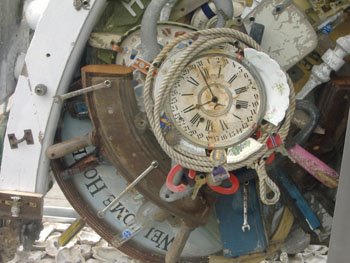
Close-up of the town Katrina Memorial.
Friday, October 26, 2007


Thursday, October 25, 2007
(Life After) Death & Taxes
An interesting post about the messed-up tax structure in Mississippi, our current gubernatorial race (bizaaaarre--see the NYTimes article entitled "In Mississippi, Democrat Runs in G.O.P. Lane," : http://www.nytimes.com/2007/10/10/us/10governor.html?_r=1&ei=5018&en=25841aa8d8ef109a&ex=1192680000&partner=BRITANNICA&pagewanted=print&oref=slogin ),
and the reasons behind our dubious distinction as #1 in the country for poverty levels. See also my comment in response--the poster brings up some interesting info, I think, but is way off-base on a couple of points.
"Only in Mississippi...."
Thanks for the link go to The Sister. :)
and the reasons behind our dubious distinction as #1 in the country for poverty levels. See also my comment in response--the poster brings up some interesting info, I think, but is way off-base on a couple of points.
"Only in Mississippi...."
Thanks for the link go to The Sister. :)
Saturday, October 13, 2007
Where Have You Been All My Life, Fall???
The great state of Mississippi finally got a touch of fall weather in the middle of this past week. This statement requires some qualification, of course--we're talking mid-80s as the high every day, with mornings brisk enough for a long-sleeved shirt if you're so inclined (which I'm not). People here wear t-shirts and shorts on Halloween, not long-johns under their costumes like where I grew up (this fact considerably improves the look of the midriff-baring Princess Jasmine combo).
Nevertheless, there's a breeze in the air and the humidity has taken a vacation to the tropics; later-blooming goldenrod is flowering all over the wild spots in the highway medians and ditches; the butterflies that folks up north have said goodbye to are flitting in between the wall frames going up on new houses being built on the beach, and hummingbirds are attacking my car when I pull up to a stop sign too close to their feeding ground (those buggers are territorial!). I've come to feel a surprising affection for the scruffy sycamore, the only tree that shows signs (albeit brown and yellow signs, not the festive red-orange-gold kind) of jumping on the fall bandwagon. It seems to have filled out all at once in a drunken foliate spree, then woken up the next morning to regret its profligate ways and promptly shed its leaves like half-eaten canapes that have been left out all night. Sycamore, you rascal!
The other way I know fall has arrived? The construction supers at the Habitat for Humanity house I worked on this morning had labeled all the interior walls and their future locations on the subfloor according to the Patriots and Colts football teams: "Hey, where's Randy Moss? Let's get him up here right next to Tom Brady and pound a few nails into him. Then we'll work on Peyton."
Ah, Fall.
Nevertheless, there's a breeze in the air and the humidity has taken a vacation to the tropics; later-blooming goldenrod is flowering all over the wild spots in the highway medians and ditches; the butterflies that folks up north have said goodbye to are flitting in between the wall frames going up on new houses being built on the beach, and hummingbirds are attacking my car when I pull up to a stop sign too close to their feeding ground (those buggers are territorial!). I've come to feel a surprising affection for the scruffy sycamore, the only tree that shows signs (albeit brown and yellow signs, not the festive red-orange-gold kind) of jumping on the fall bandwagon. It seems to have filled out all at once in a drunken foliate spree, then woken up the next morning to regret its profligate ways and promptly shed its leaves like half-eaten canapes that have been left out all night. Sycamore, you rascal!
The other way I know fall has arrived? The construction supers at the Habitat for Humanity house I worked on this morning had labeled all the interior walls and their future locations on the subfloor according to the Patriots and Colts football teams: "Hey, where's Randy Moss? Let's get him up here right next to Tom Brady and pound a few nails into him. Then we'll work on Peyton."
Ah, Fall.
Wednesday, October 10, 2007
Hungry for Debt Cancellation
I signed up for a fast 6 weeks ago in solidarity with Rev. David Duncombe of the UCC, who is undertaking a 21-day fast for debt relief for countries whose debt was not forgiven at the G8 conference. Rev. Duncombe is using this time to meet with lawmakers in Washington, D.C. to garner support for HR 2634, the Jubilee 2007 Act. This act would alleviate the debt of countries not covered in the 2005 G8 debt cancellation agreement but which are still in desperate need of debt forgiveness. The stranglehold of interest and debt payments that industrialized countries and international financial institutions (like IMF and World Bank) hold over the heads of developing countries effectivley stifles any chance they have of combating poverty and injustice in a meaningful way. Many other factors (some internal, like corruption and poor environmental stewardship; some external, like international trade and ag policies) need to change for extreme poverty to be halved by 2015, as stated in the G8's Millenium Development Goals; but continuing to exact interest and principle payments on meaningless, crippling loans which prevent developing countries from even beginning to address extreme poverty and its root causes does not help. So I've been fasting for 6 consecutive Thursdays, starting on Sept. 6 and ending tomorrow; and I've committed to repeatedly contact my Congressional representatives in an effort to pass HR 2634. The money I save from not consuming meals was sent to Heifer Project International ( http://www.heifer.org/) to help a poverty-stricken family become agriculturally sustainable, financially independent, and healthier with a gift of bees whose honey they will harvest and sell.
If you want to know why I'm doing it, here's a short explanation: http://www.jubileeusa.org/home/front-page-news/cdffeatures.html You can also link to more info about debt relief on the Jubilee website.
Fasting is--well, an interesting experience. For those of you interested in the specifics, I am not eating any solid food on the days that I fast--just liquids (water, juice, sports drinks, hot chocolate, soy milk, tea, etc.), from the time I wake up until the time I fall asleep. At first it gives you a sort of light, floaty feeling--you're zipping about and getting things done efficiently--and there's a sense that you're cleansing your body (until you drink three cups of fake powder chai tea....). But by the afternoon, around 5pm or so, I start to crash and feel a complete lack of energy and concentration. If I can keep myself busy, like teaching ESL class or hanging out drinking some juice at a friends' house while they eat a homecooked crab cakes dinner (sigh...)--then I'm fine. But if there's nothing external to do, I lay on the couch watching DVDs and barely moving, and I head for bed at 7:30 or 8. So obviously the key is staying buzzzzzy.
I find what I miss the most is not actually the taste of food or the sensation of having a full stomach, but the texture of food, the solidness of it as I chew. After your first dozen cups of microwaved apple juice, you just want to bite into a waffle or a granola bar or pudding or.... anything substantial.
Other than that--it's not bad. Friends feel guilty for eating in front of me, but it's a choice I've made. I went to visit a friend in the hospital a few weeks ago and was jokingly commiserating about how we were both on liquid diets--but she pointed out how completely different it was because hers was doctor-enforced and mine was voluntarily. It's true, and her comment was a reminder of just how disparate real hunger is compared to one day of fasting. But just a taste of that (no pun intended)--just a short time of self-imposed deprivation, is good to remind you what millions of your fellow humans go through daily. Just a taste.
If you want to know why I'm doing it, here's a short explanation: http://www.jubileeusa.org/home/front-page-news/cdffeatures.html You can also link to more info about debt relief on the Jubilee website.
Fasting is--well, an interesting experience. For those of you interested in the specifics, I am not eating any solid food on the days that I fast--just liquids (water, juice, sports drinks, hot chocolate, soy milk, tea, etc.), from the time I wake up until the time I fall asleep. At first it gives you a sort of light, floaty feeling--you're zipping about and getting things done efficiently--and there's a sense that you're cleansing your body (until you drink three cups of fake powder chai tea....). But by the afternoon, around 5pm or so, I start to crash and feel a complete lack of energy and concentration. If I can keep myself busy, like teaching ESL class or hanging out drinking some juice at a friends' house while they eat a homecooked crab cakes dinner (sigh...)--then I'm fine. But if there's nothing external to do, I lay on the couch watching DVDs and barely moving, and I head for bed at 7:30 or 8. So obviously the key is staying buzzzzzy.
I find what I miss the most is not actually the taste of food or the sensation of having a full stomach, but the texture of food, the solidness of it as I chew. After your first dozen cups of microwaved apple juice, you just want to bite into a waffle or a granola bar or pudding or.... anything substantial.
Other than that--it's not bad. Friends feel guilty for eating in front of me, but it's a choice I've made. I went to visit a friend in the hospital a few weeks ago and was jokingly commiserating about how we were both on liquid diets--but she pointed out how completely different it was because hers was doctor-enforced and mine was voluntarily. It's true, and her comment was a reminder of just how disparate real hunger is compared to one day of fasting. But just a taste of that (no pun intended)--just a short time of self-imposed deprivation, is good to remind you what millions of your fellow humans go through daily. Just a taste.
Monday, September 3, 2007
Je jure mon allégeance...
I was driving back from dropping off a friend at the New Orleans airport the other day around 5:30 am, listening to the Ragin' Cajun, 100.3 FM. It was still dark out as I cut through the city on the 610, and suddenly the station changed from your typical Zydeco-Cajun mix of accordion-laced down-homey tunes, sung in accented French, to a recording of several voices intoning cyclic chants about God, Jesus, and "le Saint Esprit." It took me a few listens to realize (being the non-Catholic that I am) that it was a congregation praying the Rosary.... in Cajun French. Weird.
Folks who have learned "Parisian" French in a sterile academic setting often find Cajun French understandable, but barely. I like to think of it as the difference between a Boston Brahmin's clean, starched-collar elocution and the bouncing, rollicking twang of a native Texan. There is something sort of buoyant about the way Cajun words drop into the mouth and tumble around, in the process smoothing away some of the sharper, more precise corners that indicate that certain "raffinement" particular to textbook French. (Montrealites (Montréalais??) sound like this to me as well--probably just my American ears' inability to hear the nuances between the two.)
The repetitive nature of the Rosary was oddly calming as I powered through narrow lanes and sharp curves, zoomed up off of an energy drink (since I'd been awake from 3am on...). I spent so many miles listening to Cajun Catholics pray that I can now say the Hail Mary in French. I have no idea how to say it in English, but since I only go to Mass when I'm in France, I guess it doesn't really matter.
The strangest part about this was crossing the I-10 Twinspan going east as the sun was rising. As the clock ticked over to 6am, an instrumental version of the national anthem struck up. Then, in a moment of bizarre cognitive dissonance, my ears filled with the sound of the Pledge of Allegiance being transmitted over the airwaves in French. I wondered if this expression of patriotism was an intentional embrace of what the United States did for the foremothers and forefathers of today's Cajuns--it was, after all, this country which welcomed the Acadian refugees when the British kicked them out of Canada. Given the long-term, deliberate persecution of French-speaking Louisianans, however, and the systematic repression of pretty much any other minority group wanting to preserve their language and cultural heritage in this country (Native Americans, Pacific Islanders, some dialect speakers, indigenous Spanish communities...), it's quite ironic that the local Cajun radio station broadcasts a Pledge of Allegiance to the government in a language which they were forbidden to speak by that very same government.
Oh, the complexities of United States history.
PS: A belated happy Indigenous People's Day (known to most of us as Columbus Day), by the way. I refer to it as the former because I'd rather celebrate the immense diversity of this land's native cultures than the man who massacred thousands of Arawak Indians in the interest of expanding Spain's imperial grasp.
Folks who have learned "Parisian" French in a sterile academic setting often find Cajun French understandable, but barely. I like to think of it as the difference between a Boston Brahmin's clean, starched-collar elocution and the bouncing, rollicking twang of a native Texan. There is something sort of buoyant about the way Cajun words drop into the mouth and tumble around, in the process smoothing away some of the sharper, more precise corners that indicate that certain "raffinement" particular to textbook French. (Montrealites (Montréalais??) sound like this to me as well--probably just my American ears' inability to hear the nuances between the two.)
The repetitive nature of the Rosary was oddly calming as I powered through narrow lanes and sharp curves, zoomed up off of an energy drink (since I'd been awake from 3am on...). I spent so many miles listening to Cajun Catholics pray that I can now say the Hail Mary in French. I have no idea how to say it in English, but since I only go to Mass when I'm in France, I guess it doesn't really matter.
The strangest part about this was crossing the I-10 Twinspan going east as the sun was rising. As the clock ticked over to 6am, an instrumental version of the national anthem struck up. Then, in a moment of bizarre cognitive dissonance, my ears filled with the sound of the Pledge of Allegiance being transmitted over the airwaves in French. I wondered if this expression of patriotism was an intentional embrace of what the United States did for the foremothers and forefathers of today's Cajuns--it was, after all, this country which welcomed the Acadian refugees when the British kicked them out of Canada. Given the long-term, deliberate persecution of French-speaking Louisianans, however, and the systematic repression of pretty much any other minority group wanting to preserve their language and cultural heritage in this country (Native Americans, Pacific Islanders, some dialect speakers, indigenous Spanish communities...), it's quite ironic that the local Cajun radio station broadcasts a Pledge of Allegiance to the government in a language which they were forbidden to speak by that very same government.
Oh, the complexities of United States history.
PS: A belated happy Indigenous People's Day (known to most of us as Columbus Day), by the way. I refer to it as the former because I'd rather celebrate the immense diversity of this land's native cultures than the man who massacred thousands of Arawak Indians in the interest of expanding Spain's imperial grasp.
Monday, August 27, 2007
2 Years and Counting...
Two years after Hurricane Katrina, life on the Gulf Coast has become a strange mix of the outwardly normal interspliced with the inwardly fragile. Storms forming in the Gulf loom over every casual conversation about the weather; a mundane review of a staff hurricane preparedness plan causes faces to cloud and shoulders to slump as coworkers relive the pain of Katrina’s chaotic aftermath. Though they faithfully show up for work, poor sleep and depression plague everyone from the cashier at the food mart down the street to Miss Gina, the woman holding together the local soup kitchen with her two hands. School-aged children cower in closets when afternoon thunder rolls on the Gulf; Miss Clara, an elderly client, blows out another year’s candles with a fervent wish not to spend her next birthday in a trailer seeping formaldehyde. There’s a sense that we are all teetering on the edge of a delicate balance between the routine and the heart-stopping.
Thankfully, physical progress continues to scramble determinedly along, thanks largely to volunteer groups like the ones that have come to serve at the organization where I work. One by one, damaged houses come back to life, as signs of recovery crop up like the morning glories in the vacant lots now dotting the city. Traffic lights have been restored on the main drag, and the bridge at the west end of Highway 90 reopened in June. Thanks to the labors of our volunteers, Miss Clara will be back in her house by Christmas instead of sometime next year. But the deepest damage wreaked by the storm—perhaps less immediately evident, but no less insidious—is that inflicted upon the spirits of those who bore the wrath of Katrina and who fight, every day, the battle of reconstructing entire lives from next to nothing. As much effort and energy as it takes to re-shingle tattered roofs, install new cabinets, repair rotten siding and replace buckled flooring, these tasks are all readily tackled with the abundance of volunteer sweat and enthusiasm which we are so blessed to have. A far more elusive commission for our community remains that of our organization's post-Katrina slogan: Rebuilding Lives, Rebuilding Hope.
As the two-year anniversary approaches, we are all called to reflect on how far we’ve come and how far we have yet to go, and what role each of us—you and I—might play in the continued effort to accomplish our mission. As welcome as physical labor and material and financial donations continue to be, taking the time to establish an exchange with local school kids*, or to write a letter of solidarity to the local paper (www.sunherald.com); calling your senators, then representatives, to ask them to push hurricane recovery funding through Congress; saying a simple prayer for the physical and spiritual recovery of the Gulf Coast—these are gifts just as valuable as a nail pounded in a two-by-four. Let the Coast know you have not forgotten them—or us, I should say, because in a way I have become a part of the community here, and I feel called to remain in Mississippi past the end of my volunteer term and to keep working for a just recovery. So I, along with the rest of the Coast, ask for your ongoing prayers and support, as we continue to Rebuild Lives and Rebuild Hope.
*http://www.greatschools.net/cgi-bin/ms/district_profile/9/ ; http://www.lbsd.k12.ms.us/ ; http://www.gulfportschools.org/index2.html ; www.biloxischools.net ; http://www.harrison.k12.ms.us/Default.aspx?tabid=135 ; http://www.ossd.k12.ms.us/
Thankfully, physical progress continues to scramble determinedly along, thanks largely to volunteer groups like the ones that have come to serve at the organization where I work. One by one, damaged houses come back to life, as signs of recovery crop up like the morning glories in the vacant lots now dotting the city. Traffic lights have been restored on the main drag, and the bridge at the west end of Highway 90 reopened in June. Thanks to the labors of our volunteers, Miss Clara will be back in her house by Christmas instead of sometime next year. But the deepest damage wreaked by the storm—perhaps less immediately evident, but no less insidious—is that inflicted upon the spirits of those who bore the wrath of Katrina and who fight, every day, the battle of reconstructing entire lives from next to nothing. As much effort and energy as it takes to re-shingle tattered roofs, install new cabinets, repair rotten siding and replace buckled flooring, these tasks are all readily tackled with the abundance of volunteer sweat and enthusiasm which we are so blessed to have. A far more elusive commission for our community remains that of our organization's post-Katrina slogan: Rebuilding Lives, Rebuilding Hope.
As the two-year anniversary approaches, we are all called to reflect on how far we’ve come and how far we have yet to go, and what role each of us—you and I—might play in the continued effort to accomplish our mission. As welcome as physical labor and material and financial donations continue to be, taking the time to establish an exchange with local school kids*, or to write a letter of solidarity to the local paper (www.sunherald.com); calling your senators, then representatives, to ask them to push hurricane recovery funding through Congress; saying a simple prayer for the physical and spiritual recovery of the Gulf Coast—these are gifts just as valuable as a nail pounded in a two-by-four. Let the Coast know you have not forgotten them—or us, I should say, because in a way I have become a part of the community here, and I feel called to remain in Mississippi past the end of my volunteer term and to keep working for a just recovery. So I, along with the rest of the Coast, ask for your ongoing prayers and support, as we continue to Rebuild Lives and Rebuild Hope.
*http://www.greatschools.net/cgi-bin/ms/district_profile/9/ ; http://www.lbsd.k12.ms.us/ ; http://www.gulfportschools.org/index2.html ; www.biloxischools.net ; http://www.harrison.k12.ms.us/Default.aspx?tabid=135 ; http://www.ossd.k12.ms.us/
Wednesday, July 18, 2007
And..... We're Back!
As I have been reminded/chastised by more than one person in the last few weeks (and I am surprised and grateful that this many people care!), I have not been posting regularly as of late. This is due to a combination of extreme busyness at work, being out of town on several weekends, having guests/friends come to visit, and being in a general funk about writing. As faithful readers out there may remember, my first post was called "Waiting for the Rain"--and I am here to say that the drought is over!
What kicked me back into gear today was a small thing, despite the pre-existing weight of some very rich experiences bearing down on me and just crying out to be dissected and processed. In fact, it was a very ordinary, everyday object that most of us probably don't even consciously notice. My zeal for blogging was reignited by a mailbox.
On our post-lunch surveying run, however, we encountered none of the above. We were driving north of the tracks, attempting to find a bit of a street that had suddenly stopped on the south side of the tracks and was supposed to pick up several blocks down on the other side. We finally found the street, but all it took was a once-over to realize that it was nothing but a string of empty lots, each one so overgrown that they ran together into one long, unruly field. Apparently they hadn't been touched in years, or maybe decades; there was little hope of finding any of the addresses we'd been given to check off our list, 342-360 Saratoga. As I was executing a 3-point turn to head over to the next grid square on our survey maps, a volunteer in the back seat said, "Yep, there's 342--we're in the right place. No houses, though." I turned to ask how he knew which lot we were on, and saw a black metal mailbox almost buried in vegetation, stubbornly bent at a gravity-defying angle. The metallic stickers on its side announced that it was, in fact, #342. The fact that this used to be a house, a home--an entire life--suddenly hit me in the gut, going deeper than the constant, wearying deluge of statistics and stories, zeroing in on the place where you finally get it. Oof. This entire street used to be populated, lively; there was a lone, defiant mailbox with a clearly printed address to prove it right in front of us. Across the street, I could suddenly make out an empty dog kennel with the door hanging open. Traces of whole lives. Where are these people now? Down the block awaiting the funds to rebuild? Moved away to a fresh start? Dead?
Destroyer of records and pillager of essential papers, Katrina hit hard in this data-obsessed country, where you don't really exist unless you have an address. Those powerful little numbers give you someplace to receive mail and bills; they enable you to get a library card or a driver's license, file for taxes or apply for a new social security card; they mean you can vote as a citizen of the United States and indicate where you can do so; they tell the power company which transformer to repair when the lights go out and the customer service lady at the waste management company where your garbage gets picked up; they even allow the pizza delivery people to find you. My housemate and I just recently got an official address for our longterm volunteer house and spent a quarter of an hour screwing plastic numbers onto our gable end, thus declaring our newfound legitimacy to the world; I suddenly felt safer because an ambulance or a fire truck would now know how to get to us in an emergency.
An address puts you on the map, literally and figuratively--if there had been no mailbox, no address on that lot today, we would not have been able to officially mark off Lot #432 as "vacant/abandoned" on our survey grid. That was what was so depressing about it, I suppose--today, instead of being the emblem that facilitates so many daily tasks and validates an entire existence, those numerals were a death knell, proof positive that what once existed so definitively, no longer does. Today, those numbers were the embodiment of all that has been lost here on the Coast.
What kicked me back into gear today was a small thing, despite the pre-existing weight of some very rich experiences bearing down on me and just crying out to be dissected and processed. In fact, it was a very ordinary, everyday object that most of us probably don't even consciously notice. My zeal for blogging was reignited by a mailbox.
For the past few weeks, our agency has been supplying volunteers to the local coordination center, which orchestrates the relief efforts of the dozen+ organizations doing rebuilding work in our immediate community. The coordination center has been utilizing our volunteers (amongst others) to conduct site-by-site surveys of the area's neighborhoods in order to determine the condition of the buildings on each lot, who owns them, and where the owners are in the recovery process. This information helps to direct the center's outreach efforts and rehab initiatives, and generally allows everyone to gauge the community's progress on the monumental path to recovery. It's hot, long work, but it can be very rewarding because it gives volunteers the opportunity to interact with local residents in a meaningful way--in responding to the survey questions, residents will often spend 15 or 20 minutes, or longer, reliving the hurricane and its aftermath and simply sharing their incredible, emotional stories with the volunteers. Those administering the survey encounter gratefulness, anger, hope, despair, friendliness, slamming doors, the peculiar love/hate relationship with FEMA, and the inevitable Chatty Cathy (or Carl).
On our post-lunch surveying run, however, we encountered none of the above. We were driving north of the tracks, attempting to find a bit of a street that had suddenly stopped on the south side of the tracks and was supposed to pick up several blocks down on the other side. We finally found the street, but all it took was a once-over to realize that it was nothing but a string of empty lots, each one so overgrown that they ran together into one long, unruly field. Apparently they hadn't been touched in years, or maybe decades; there was little hope of finding any of the addresses we'd been given to check off our list, 342-360 Saratoga. As I was executing a 3-point turn to head over to the next grid square on our survey maps, a volunteer in the back seat said, "Yep, there's 342--we're in the right place. No houses, though." I turned to ask how he knew which lot we were on, and saw a black metal mailbox almost buried in vegetation, stubbornly bent at a gravity-defying angle. The metallic stickers on its side announced that it was, in fact, #342. The fact that this used to be a house, a home--an entire life--suddenly hit me in the gut, going deeper than the constant, wearying deluge of statistics and stories, zeroing in on the place where you finally get it. Oof. This entire street used to be populated, lively; there was a lone, defiant mailbox with a clearly printed address to prove it right in front of us. Across the street, I could suddenly make out an empty dog kennel with the door hanging open. Traces of whole lives. Where are these people now? Down the block awaiting the funds to rebuild? Moved away to a fresh start? Dead?
Destroyer of records and pillager of essential papers, Katrina hit hard in this data-obsessed country, where you don't really exist unless you have an address. Those powerful little numbers give you someplace to receive mail and bills; they enable you to get a library card or a driver's license, file for taxes or apply for a new social security card; they mean you can vote as a citizen of the United States and indicate where you can do so; they tell the power company which transformer to repair when the lights go out and the customer service lady at the waste management company where your garbage gets picked up; they even allow the pizza delivery people to find you. My housemate and I just recently got an official address for our longterm volunteer house and spent a quarter of an hour screwing plastic numbers onto our gable end, thus declaring our newfound legitimacy to the world; I suddenly felt safer because an ambulance or a fire truck would now know how to get to us in an emergency.
An address puts you on the map, literally and figuratively--if there had been no mailbox, no address on that lot today, we would not have been able to officially mark off Lot #432 as "vacant/abandoned" on our survey grid. That was what was so depressing about it, I suppose--today, instead of being the emblem that facilitates so many daily tasks and validates an entire existence, those numerals were a death knell, proof positive that what once existed so definitively, no longer does. Today, those numbers were the embodiment of all that has been lost here on the Coast.
Subscribe to:
Posts (Atom)